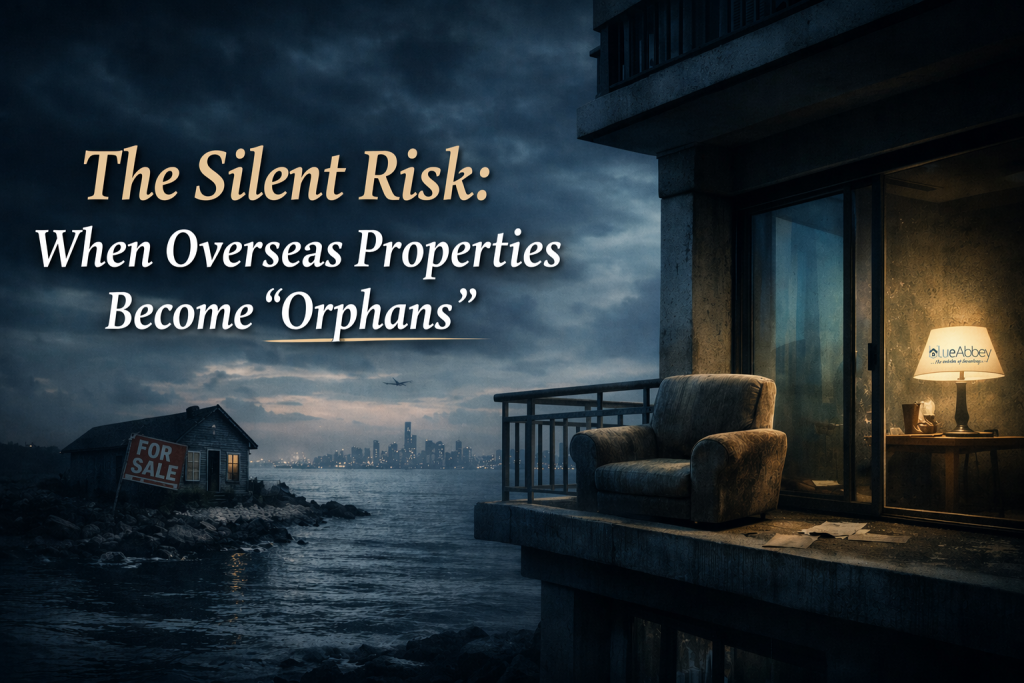
Investing in overseas property is often associated with long-term value preservation, currency diversification, and portfolio expansion. Yet beyond the acquisition phase, there is a quieter, often overlooked risk—properties that are left without proper oversight once the transaction is completed.
These are what we refer to as “orphaned properties”. They are not abandoned in ownership, but in attention.
What Defines an “Orphaned Property”?
An overseas property becomes “orphaned” when there is no consistent, on-the-ground coordination to ensure its upkeep, usability, and market readiness.
This is far from an isolated phenomenon. When investors are based overseas, dependent on sales agents whose capabilities or professionalism may not be fully aligned, or simply underestimate the ongoing commitment and complexity involved, issues rarely surface all at once. They build quietly. What begins as minor details can, over time, become defining problems.
The Risks That Build Quietly
Unlike market volatility, these risks do not emerge overnight. They accumulate gradually, often unnoticed until they begin to affect returns or asset condition.
• Delayed maintenance and unnoticed defects
Minor issues left unattended can escalate into costly repairs.
• Inconsistent tenant experience
Poor coordination can affect occupancy rates and tenant retention.
• Inefficient leasing cyclesIn Malaysia, for example,In Malaysia, for example,
Without timely preparation and positioning, properties may sit idle longer than expected.
• Asset underperformance despite market strength
Even in resilient markets, poorly coordinated units tend to lag.
• Local regulatory and policy considerations
Including personal income tax filings and property-related taxes such as assessment tax and quit rent.
Beyond Distance: Legal and Language Realities
Distance is often seen as the primary challenge in overseas ownership. In reality, it is the complexity of legal frameworks, documentation processes, and compliance requirements that proves equally demanding. For investors entering the Malaysian, Japanese, or wider global property markets, the lack of on-the-ground experience often turns what appears manageable into a far more demanding undertaking.
Language, too, adds another layer. In Malaysia, for example, while English and Chinese are widely used in daily interactions, Bahasa Malaysia remains the official language for legal documents, government procedures, and formal communications. This means that key processes—from agreements to submissions—are often conducted primarily in Malay.
Without clarity and proper interpretation, even routine matters can become sources of delay or misunderstanding.
From Ownership to Stewardship
A well-performing overseas property is rarely the result of passive ownership. It requires continuity—consistent standards, timely execution, and local insight.
Owning a property is one thing. Ensuring it continues to perform is another.
A More Assured Approach
In cross-border investments, local coordination is not optional—they are essential.
At 3E ABROAD, together with our affiliated company, Blue Abbey Sdn. Bhd., we support property owners through each stage of their journey, from initial setup and furnishing to tenant readiness and ongoing coordination on the ground.
With a structured and integrated approach, investors are able to navigate local requirements, operational details, and market positioning with greater confidence, allowing their assets to remain active, aligned, and well cared for. So that ownership, even from afar, can be managed with clarity—and with ease.
👉🏽READ MORE: Blue Abbey Property & Local Services